

Role of 5-Axis Vertical Machining in Mold & Die Manufacturing

Updated: Apr 30

Are you tired of constantly repositioning parts just to achieve tight tolerances? In mold and die manufacturing, producing complex geometries with traditional axis machining can be time-consuming and prone to errors. Multiple setups and manual adjustments not only slow down production but can also affect accuracy.
That’s where 5-axis vertical machining makes a significant difference. By incorporating two additional rotational axes, the cutting tool can approach the workpiece from virtually any angle. Want to know how else this tool contributes in mold & die manufacturing? This blog post covers it all! In this, you will learn about the key role the 5-axis vertical machining center plays in modern mold and die manufacturing. Let’s get straight into it!
Overview of 5-Axis Vertical Machining in Mold & Die Manufacturing5-axis vertical machining revolutionizes mold and die manufacturing by enabling continuous movement across five axes, allowing operators to machine complex geometries in a single setup. The mold-making industry demands flawless dimensional accuracy, superior surface finishes, and the ability to cut hardened materials. 5-axis technology meets these demands by utilizing shorter, rigid cutting tools that reduce vibration and eliminate the need for manual polishing. By reducing setups and maintaining optimal cutting angles, manufacturers boost productivity, extend tool life, and accelerate production times. The Campro NU-550 is highly recommended for these tasks, offering a 30 kW spindle and a stable Monoblock structure to ensure unmatched precision and efficiency. |
Introduction to 5-Axis Vertical Machining
You probably already know how standard 3-axis machines operate. They move cutting tools across the X, Y, and Z linear axes. A 5-axis vertical machining center takes this setup and adds two rotary axes, typically the A and C axes. This allows the cutting tool or the workpiece to tilt and rotate dynamically while the spindle cuts the material.
Instead of manually repositioning a heavy block of steel multiple times to reach different sides, a 5-axis machine accesses five distinct sides of a part in a single setup. This continuous movement lets you machine incredibly complex shapes seamlessly. You spend less time setting up jobs and more time actually cutting metal, drastically improving your shop's overall productivity and output quality.
Why Mold & Die Manufacturing Requires High Precision?
The mold and die industry faces a unique set of pressures. Manufacturers create molds that serve as the foundation for mass production in industries such as automotive, aerospace, and consumer goods. These molds directly shape how every final product looks and functions. Even a small imperfection in a mold can repeat itself across thousands or even millions of manufactured parts. Here’s a closer look at the reasons behind the importance of high precision in mold and die industry:
Dimensional Accuracy: Molds must meet exact, uncompromising specifications for proper fit and function of the final molded parts. Do you know what happens when there is a deviation of just a few microns? It can cause part flashing, poor surface finishes, or even complete mechanical failure of the component.
Complex Part Geometries: Modern product designs are rarely simple. They feature organic curves and deep cavities. Traditional machining methods often struggle to reach these deep crevices without introducing vibration or tool deflection. High-precision equipment is mandatory to navigate these complex geometries smoothly and accurately.
Surface Finish Requirements: High-precision machining produces an exceptionally smooth, near mirror-like surface directly from the machine. This level of finish is crucial because the condition of the mold surface directly affects how easily the final product releases. When a mold contains chatter marks or visible tool lines from the machining process, those same imperfections are transferred onto every molded part.
Material Hardness: Tooling relies on incredibly tough materials such as hardened tool steels, titanium, and advanced alloys. These metals are chosen because they can withstand the intense, repetitive pressures of injection molding and metal stamping. Machining these tough materials accurately requires rigid, high-performance equipment that can maintain exact tolerances even under incredibly heavy cutting loads.
Why 5-Axis Machining is Best for Mold & Die Manufacturing?
When you transition to a 5-axis vertical machining center, the operational benefits compound immediately. The technology specifically addresses the most frustrating bottlenecks found in traditional mold making.
Shorter Cutting Tools: Because the machine head or the table tilts, you can get much closer to the workpiece. This allows you to use shorter, more rigid cutting tools. Why does this matter? Shorter tools drastically reduce vibration, prevent tool deflection, and allow for much higher cutting speeds. This directly translates to an exceptional surface finish that requires little to no manual polishing once the part leaves the machine.
Fewer Setups: By reaching five sides of a part simultaneously, you eliminate the need to manually flip and realign the workpiece multiple times. This massive reduction in handling removes the risk of alignment errors that naturally occur every time an operator moves the part.
Extended Tool Life: Replacing cutting tools constantly eats into your profit margins. 5-axis machines help solve this by maintaining optimal cutting angles between the tool and the material surface at all times. Keeping a consistent chip load reduces excessive friction and heat buildup. Ultimately, this prolongs the life of your expensive cutting tools and keeps your machine running longer without interruptions.
Faster Production Times: Combining fewer setups, higher feed rates, and reduced manual finishing means you can complete complex molds much faster. This accelerated turnaround time allows you to take on more jobs, increase your shop's throughput, and deliver flawless products to your clients well ahead of schedule.

Best Recommended 5-Axis Vertical Machining For Mold & Die Manufacturing
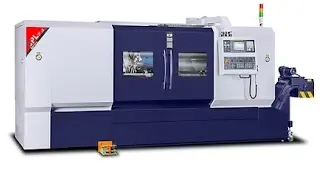
At Campro USA, the Campro NU-550 is the ultimate choice for mold and die manufacturing. When you buy this CNC machine online, you get the speed, stability, and value needed for high-level mold making. Here is the list of features that you get to enjoy with this 5-Axis VMC:
High-Speed Spindle: Need power for tough tool steels? The 12,000 rpm I.D.D. spindle with a 30 kW motor delivers high speed and strong cutting performance.
Rigid Monoblock Structure: Precision needs stability. The one-piece monoblock column and base reduce vibration and improve rigidity.
Advanced Engineering Design: Designed using 3D software and FEA analysis. This ensures better structural stability and long-term accuracy.
Double-Arm Supported Tilting Rotary Table: Working on complex parts? The tilting rotary table supports smooth full 5-axis movement.
32-Tool Automatic Tool Changer (ATC): Want faster production? The 32-tool ATC enables quick and efficient tool changes.
Twin Chip Screws: Chips piling up? Twin chip screws remove chips quickly and keep the machine clean.
Compact Footprint: Limited floor space? The compact design delivers precision without taking up much room.
Stable Heavy-Cutting Performance: Need consistent results? The machine stays stable during heavy cutting operations.
Ready to take your mold and die production to the next level? Contact us today to schedule a demo of the CNC Machines and see the precision and efficiency for yourself!
FAQ’s
What is the main difference between 3-axis and 5-axis machining?
A 3-axis machine moves a cutting tool along the X, Y, and Z linear axes. A 5-axis machine adds two rotational axes (usually A and C), allowing the tool or the table to tilt and rotate. This enables access to five sides of a workpiece without manually repositioning it.
Does 5-axis machining eliminate the need for hand polishing molds?
In many cases, yes. The ability to use shorter cutting tools and maintain optimal tool angles minimizes chatter and vibration. This produces exceptionally smooth surface finishes straight out of the machine, heavily reducing or entirely eliminating manual polishing.
Is the Campro NU-550 suitable for hard metals?
Absolutely. The NU-550 comes equipped with a powerful 12,000 rpm I.D.D. spindle and a 30 kW motor. Combined with its rigid Monoblock base, it easily handles the hardened tool steels and complex alloys commonly used in mold and die manufacturing.
Is 5-axis machining suitable for producing deep cavities in molds?
Yes, 5-axis machining is ideal for deep mold cavities. The machine tilts the spindle or table, allowing better tool angles, shorter cutting tools, improved stability, and precise machining in difficult-to-reach areas.
What software is required for programming 5-axis machining?
Advanced CAD and CAM software is required to program 5-axis machining. These tools create complex mold designs, generate accurate toolpaths, and simulate machining operations to prevent collisions and improve efficiency.


Comments