

CNC Machining Explained: Machine Types, Performance Factors, Industry Uses & Selection Guide

Updated: 7 days ago

As manufacturing demand increases, achieving precision and scalability becomes crucial for every business. However, traditional manual operations lead to human error, material waste, and design limitations that stall business growth. To rectify this, CNC machining, with its computer-automated control capabilities, provides the essential automation and accuracy to effectively overcome these challenges.
By exploring various machine types and industry applications, this guide helps you identify how selecting a reliable CNC machine optimises production, reduces overhead, and gives high-quality results.
CNC Machine Types — Classification, Configurations and Industrial Applications
How CNC Machines Are Classified and What Each Category Is Designed to Do
The CNC machine uses a software program to automate machining processes. Using G-code and M-code, this machine controls tools such as drills, turning tools, and milling cutters. More detailed information on CNC machine types and their relevant industrial uses is as follows:
Main machine Categories
Milling: This machine uses a rotating cutting tool to remove material while keeping the material stationary on a table. This can be used to carve complex shapes, pockets, and holes.
Turning: It rotates a workpiece at high speeds, while the stationary cutting tools shape it. It is particularly designed for cylindrical parts like shafts, bolts, and pistons.
Grinding: To achieve a high surface finish and tight tolerances, this machine uses an abrasive wheel to remove minute amounts of material. It’s often used on hardened materials to get an accurate final dimension.
EDM: Rather than physical cutting, this machine uses controlled electrical discharges to erode the material. It is specifically used on extremely hard metals or intricate shapes, where traditional tools can break.
What Axis Count Means for CNC Capability
Axis count stands for the degree of freedom of a machine. It helps to know how many independent directions a machine tool can move or rotate. In a typical vertical machining center, the axes are positioned as follows:
X: left–right
Y: front–back
Z: up–down
A / B / C: rotational axes around X, Y, Z.
Here are some common axis configurations:

Vertical Machining Centers (VMCs): Structure, Variants and Application Fit
A CNC milling machine having vertically oriented spindles that approach the workpiece from above, mounted on a horizontal table, is known as a vertical milling centre.
Core components and functional components of VMC
A Vertical Machining Center (VMC) consists of several essential components that work together to perform machining operations effectively. Each component plays a specific role in ensuring accuracy, stability, and efficiency.
The Vertical Spindle: The spindle holds and rotates the cutting tools. For high-performance VMC’s, spindles are often direct drive or geared, allowing 8-15000+ RPM. This enables handling everything from heavy steel roughing to fine finishing of aluminium.
Automatic Tool Changer: Another important component is an ATC. It is designed to swap cutting tools in seconds without manual input, reducing downtime and increasing productivity. Twin-arm ATCs are the industrial preference for speed, while Umbrella types offer a simpler, cost-effective solution for lighter duty.
Rigid Cast Iron Frame: High-tier VMCs utilize Meehanite cast iron (including Campro), providing the mass and thermal stability required to prevent chatter (vibration) during aggressive cutting cycles.
How Box Way and Linear Guideway VMCs Differ in Load Capacity and Cutting Characteristics
Here is a comparison table that discusses the Box Way and Linear Guideway VMC’s to better understand their load capacity and cutting characteristics:
Feature | Box Way VMC | Linear Guideway VMC |
Load Bearing Capacity | Broad contact surfaces easily support massive workpieces and heavy table loads. | Concentrated rolling points limit total load capacity compared to solid ways. |
Cutting Force Resistance | Superior resistance to aggressive cutting forces and sudden shock loads. | Best suited for light-to-medium carving rather than aggressive cutting forces. |
Vibration Damping | Naturally dampens harmonics, preventing tool chatter during deep cuts. | Lower damping properties may transmit vibrations during high-torque tasks. |
Machining Speed | Sliding friction results in slower rapid traverses and steadier feed rates. | Low-friction rails allow for high acceleration and much faster cycle times. |
Application Fit | Built for oversized parts, tough-to-cut metals, and deep, aggressive carving. | Ideal for intricate designs, smooth finishes, and high-volume production of precision parts at top speed. |
As we have seen the differences between the two VMCs, you can also refer to "Efficient Box Way Construction in VMCs: How It Works" for a better understanding of demanding machining environments.
CNC Turning Centers and Lathes: Configurations, Live Tooling and Application Range
How a CNC Turning Center Differs From a Basic CNC Lathe
A basic CNC lathe differs in its limited axis interpolation, absence of live tooling, and lack of spindle-turret synchronization, while a CNC turning center integrates synchronized multi-axis control (C/Y/B axes), live tooling, and sub-spindle capability. These advanced features are the reason why CNC turning machines are essential for modern manufacturing, delivering precision, efficiency, and complex part capabilities.
Machine Configurations: Lathes vs. Turning Centers
Basic CNC Lathe: Typically designed as a 2-axis machine(X, Z) suitable for simpler, high-speed turning and threading. These are often flat-bed designs, making them ideal for cylindrical parts, short production runs, and manual repairs.
Now the main question: how do CNC lathe machines control thermal expansion? Well, they use thermal compensation software, temperature sensors, and controlled spindle cooling to adjust tool paths in real time.
CNC Turning Center: These are usually slant-bed designs offering rigidity and chip management. The turning centres incorporate an advanced multi-axis system(3-5+ axes), preferable for milling, drilling, and tapping in a single setup.
How Live Tooling Expands the Turning Center's Capability
Traditionally, the workpiece rotates while the tool remains stationary. Live tooling flips this workflow by equipping the turret with its own motor, allowing powered tools to spin while the machine’s main spindle is locked or indexed by using the C-axis.
It enables operations like slotting, cross-drilling, flat machining, and contouring. This significantly reduces setup changes, handling errors, and cycle time, especially for multi-feature parts.
When Twin-Spindle Lathes Are Used and What Production Advantage They Provide
Twin-spindle lathes are mainly used in high-volume production to machine both sides of a component automatically. The production advantages include:
Eliminate manual flipping.
Reduce cycle times.
Ensure perfect concentricity for complex geometries.
What Materials and part geometries are CNC turning best suited for
It is best suited for steel, stainless steel, aluminium, brass, copper, and titanium.
For the geometries, it works effectively on cylindrical shapes like shafts, bushings, pins, and pulleys.
Horizontal Machining Centers (HMCs): Chip Flow, Pallet Systems and High-Volume Use
Horizontal Machining Spindle Orientation
This orientation allows gravity to naturally pull chips away from the cut zone, which prevents recutting, heat buildup, and tool wear. Therefore, reduces heat transfer to the workpiece, ensuring better thermal stability.
Pallet Systems
An APC allows operators to load or unload parts on one pallet while the machine remains in a high-speed cutting cycle on another, maximizing spindle utilization and production uptime.
High Volume Use
VMCs are favored in industries like precision engineering, electronics, and mold making, for smaller, complex, or high-accuracy parts. HMC’s are preferred in automotive, aerospace, heavy machinery, and energy sectors.
Fixture Tombstones
Mounted on a rotating 4th-axis pallet, tombstones enable multi-part clamping. This enables the machine to mill multiple sides of several components in a single, uninterrupted setup.
Bridge Mills and Double Column Machining Centers: Large-Format Precision Machining
For large-format precision machining, here is how to choose a heavy-duty Bridge mill ensuring optimal spindle performance for consistent accuracy on oversized parts.
Bridge Mill
Unlike the single-column C-frame of a VMC, a Bridge Mill has two vertical columns supporting a crossbeam, providing a much wider, more stable foundation for heavy-duty, large-envelope machining.
Monobloc Bridge Construction
This one-piece cast iron design distributes cutting forces symmetrically and absorbs vibration, ensuring micron-level accuracy even during aggressive material removal on massive workpieces.
Industries Require Bridge Mill Capacity and Part Sizes They Handle
These are essential for aerospace, energy, and die & mold sectors.
Handles oversized parts like aircraft wing spars, wind turbine hubs, and multi-ton automotive stamping dies.
Selection Criteria for Choosing a Heavy-Duty Bridge Mill
Essential requirements for choosing a heavy-duty Bridge mill include structural rigidity, spindle power/torque, thermal stability, guideway design, work envelope, and vibration control.
5-Axis Machining Centers: Kinematics, Configurations and Complex Geometry Capability
The 5-axis machining centres integrate 2 rotary axes (A and C or B) and 3 linear axes (X, Y, and Z) that move simultaneously, allowing the tool to approach surfaces from virtually any angle for complex contours.
Here are some of the working aspects and advantages of the Trunnion-Table:
Trunnion‑Table machines rotate the workpiece on a moving table, while the Swivel-Head machine pivots the spindle.
Parts with compound angles, freeform contours, deep cavities, impellers, and sculpted surfaces demand a 5‑axis setup, as a 3-axis setup can result in limited tool orientation and minimal setups.
The top advantages of using a 5-Axis vertical machining center include superior precision for aerospace, medical implants, automotive, and energy components, achieving micron-level tolerances with minimal setups.
CNC Milling Machines — Technology, Features, Selection and Performance
How a CNC Milling Machine Works: Cutting Mechanics and Machine Architecture
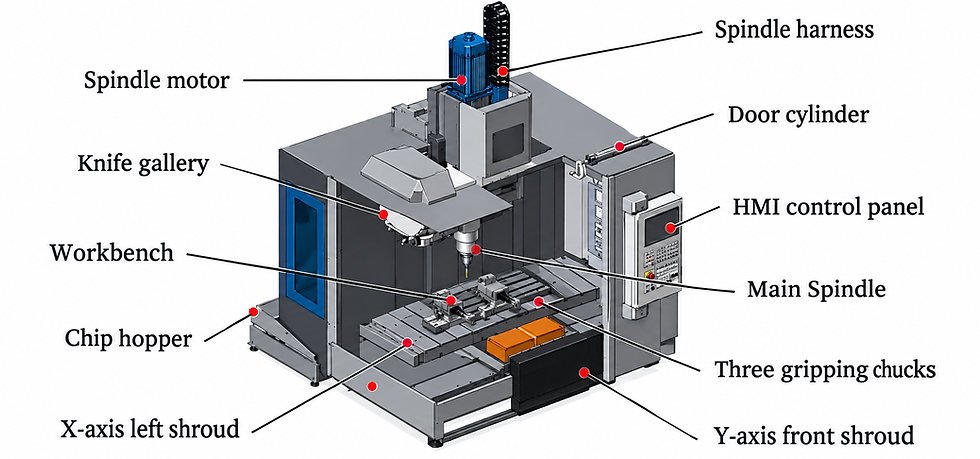
Spindle-Workpiece Interface
At the spindle-workpiece interface, rotating cutting edges apply concentrated shear stress to fracture material into chips. This process demands precise spindle speeds and optimized coolant delivery to prevent thermal expansion and maintain surface integrity, key reasons why understanding the top features to look for in a modern CNC milling machine is essential for achieving optimal performance.
Structural Loop
The interconnected bed, column, saddle, and table form a closed loop that resists deflection and thermal expansion, ensuring the tool’s position relative to the workpiece remains perfectly constant.
Role of Components in Axis Motion
Ballscrews and linear guides convert rotary motion to precise linear movement, while servo drives provide controlled speed and sub-micron positioning needed for complex geometries.
Controllers Translation
The CNC controller processes G-code to perfectly sync axis and spindle movements, enabling complex tool paths and ensuring precise machining operations.
Spindle Performance: Speed, Torque, Taper Standards and Toolholder Compatibility
Let’s understand how spindle performance plays a crucial role in CNC milling with essential factors:
Speed (RPM): It defines the rotational rate at which the spindle turns the tool, resulting in chip formation with a proper surface finish. The right speed balances productivity with thermal and vibration control.
Torque: The spindle’s ability to maintain cutting forces without bogging down at higher RPM is a function of torque. It is required to cut harder materials such as steel, Titanium, and hard alloys.
Taper Systems: Some of the taper systems include CAT40, CAT50, and BT40. These refer to standardized spindle taper systems with a 7:24 steep taper profile, and distinguishing between them ensures proper toolholder fit, rigidity, and machining accuracy.
CAT40 vs. CAT50: While sharing the same taper angle, the larger CAT50 frame provides the extreme rigidity needed for heavy-duty cutting, whereas CAT40 offers a faster, more efficient balance for general-purpose machining.
BT40 vs. CAT40: Despite identical 7:24 geometries, the BT40 uses a symmetrical metric flange, while CAT40 uses an offset imperial design, making them non- interchangeable on most automatic tool changers.
Toolholder compatibility: The system consists of Big-Plus to utilize dual-contact technology to engage both the taper and the spindle face simultaneously. This eliminates the traditional gap, preventing tool pull-in caused by centrifugal expansion and significantly increasing axial rigidity during high-speed machining.
Guideway Systems: Box Way vs Linear Guideway — Performance Trade-offs
The performance trade-offs describe how guideway systems are needed for factory-level precision
By utilizing high-surface-area sliding contact and a pressurized oil film, Box-way guideways achieve the superior damping and load capacity required for heavy cutting.
Incorporating recirculating ball or roller bearings, linear guideways enable high-speed, low-friction motion for exceptional contouring accuracy.
The applications that favor both guideway types are:
Aerospace and Energy favor the rigidity of the Box-way guide.
Medical and Die & Mold sectors prioritize linear guides.
Key Specifications to Evaluate When Selecting a CNC Milling Machine
Here are the top features to look for in a modern CNC milling machine for precision machining:
Axis Travel and Work Envelope
Defines the maximum part size the machine can handle; consider X, Y, Z travel, and table size for part dimensions and fixture flexibility.
Rapid Traverse and Feed Rates
Higher rapid speeds reduce non-cutting time, but the acceleration/deceleration (G-rate) is more important for complex 3D contouring and short-distance movements.
Tool Changer Capacity and Chip-to-Chip Time
The number of pockets in the Automatic Tool Changer (ATC) dictates part complexity, while a fast chip-to-chip time minimizes idle periods, directly increasing your overall equipment effectiveness (OEE).
What Coolant System Options Are Available and When Each Is Used
Flood Coolant Systems
Utilizing high-volume, low-pressure nozzles to drench the cutting zone, this system is the industry standard for general-purpose machining, providing excellent cooling and washing away chips from the table surface. Flood is best for heavy-duty operations
Through-Spindle Coolant (TSC)
Delivering high-pressure fluid directly through the center of the cutting tool, TSC is indispensable for deep-hole drilling and pocket milling where external nozzles cannot reach, as it forces chips out of the cavity to prevent re-cutting. TSC is best for precision and deep or high-speed cutting.
Mist Coolant Systems
Mist systems atomize coolant into a fine spray, providing light lubrication and some cooling without excessive fluid use. Mist is suitable for light cutting, finishing operations, or materials like aluminum, where minimal thermal distortion is required and chip evacuation is less critical.
CNC Machining Performance Factors: What Influences Accuracy, Speed, and Surface Finish
CNC machining performance depends on several interconnected factors that influence how accurately, quickly, and consistently a machine produces finished parts. Machine rigidity, spindle performance, feed rate, tooling, thermal stability, guideway design, coolant delivery, and workholding can each affect machining results. This infographic highlights these key factors and shows how they contribute to accuracy, machining speed, vibration control, tool life, and surface finish.

CNC Turning Centers and Lathes — Mechanics, Configurations, and Material Capability
How CNC Turning Works: Spindle Rotation, Turret Tooling, and Axis Control
Spindle rotation
In CNC turning, the spindle holds and rotates the workpiece at high velocity to provide the primary cutting motion against a stationary tool.
Turret tooling
The turret acts as a high-precision indexable tool carrier, holding multiple inserts for outer diameter turning, internal boring, and specialized threading operations.
Axis control
Modern CNC lathes operate along multiple axes. It utilizes the Z-axis for longitudinal travel and the X-axis for diameter control, while advanced units add a Y-axis for off-center milling operations. The advanced machines include Y, C, or B axes for milling or angled cuts. This is why CNC turning machines are essential for modern manufacturing.
Thermal Expansion in CNC Lathes: Causes, Effects, and Compensation Methods
Causes of thermal expansion
Thermal expansion leads to dimensional drift, altered tool tip position, and variations in part size over long runs, often exceeding tight tolerance limits.
Effects on Accuracy
Thermal growth alters spindle length, axis positioning, and machine structure symmetry, causing dimensional drift, surface finish variation, and positional inaccuracy during long or high‑speed operations.
What Thermal Compensation Algorithms Do and How They Maintain Tolerances
CNC controllers use mathematical models and sensor feedback to calculate real-time coordinate offsets, automatically adjusting the tool position to counteract predicted structural expansion. This mechanism explains how CNC lathe machines control thermal expansion for consistent accuracy.
How Spindle Chiller Units and Symmetric Machine Design Reduce Thermal Growth
Spindle chillers and thermal control systems remove heat at the source, while symmetric machine designs and materials with low expansion coefficients reduce uneven heating and overall thermal distortion.
What the ISO Standard for Thermal Testing of Machine Tools Requires
This international standard defines the methodology for testing and evaluating the thermal effects on machine tool accuracy, specifically measuring environmental temperature variations and spindle-generated heat.
CNC Turning Applications: Materials, Industries and Part Families
These turning machines are primarily utilized to manufacture high-precision shafts, bushings, valves, and threaded fasteners where rotational symmetry and concentricity are critical.
Considering various CNC machine types and their relevant industrial uses, aerospace relies on lathes for engine disks and landing gear; automotive for crankshafts and axles; oil and gas for heavy-duty drill pipe connectors; and medical for tiny, intricate orthopedic implants.
The material properties dictate specific machining strategies; aluminum requires high surface speeds and sharp geometries; steel necessitates robust torque, while Titanium and superalloys demand high-pressure coolant and rigid setups to manage intense heat and work hardening.
Turn-mill centers integrate rotational turning and multi-axis milling into a single setup, drastically reducing cycle times and eliminating alignment errors for complex parts like splines and pockets.
Find the right CNC machine for your production goals with Campro USA’s precision-engineered solutions, built for demanding machining requirements!
CNC Machining by Industry — Aerospace, Medical, Automotive and Die/Mold
Aerospace Manufacturing: Tolerances, Materials, and Regulatory Requirements for CNC-Machined Parts
AS9100 and NADCAP Compliance: AS9100 ensures a rigorous quality management system for aerospace-grade manufacturing, while NADCAP validates critical special processes like heat treating and non-destructive testing.
Exotic Material Machining: Aerospace CNC operations use high-torque spindles for titanium, high-speed spindles for aluminium alloys, and specialized ceramic tooling for nickel-based superalloys such as Inconel.
Structural Component Requirements: Machining frames, brackets, and turbine blades require extreme structural rigidity and thermal stability to maintain tolerances within ±0.002 mm under heavy cutting loads.
Essential 5-Axis Machining: 5-axis systems are critical in aerospace, as they enable complex, freeform geometries and undercuts to be machined in a single setup. This is one of the top advantages of using 5-axis vertical machining in aerospace manufacturing, as it eliminates the cumulative errors from multiple fixings.
Medical Device Manufacturing: Biocompatibility, Precision and CNC Process Control
Medical Precision: CNC Swiss-type lathes and micro-milling machines are utilized to produce intricate orthopedic implants and surgical instruments from biocompatible materials like Titanium and PEEK.
Automotive Production: High-volume horizontal machining centers (HMCs) are the standard for engine blocks and transmission housings, prioritizing rapid cycle times and automated part loading. Thus, medical device manufacturing with CNC milling machines operates under a similar precision-driven philosophy.
Die and Mold High-Finish: Die/mold machining requires spindles exceeding 20,000 RPM and advanced control software to achieve the mirror-like surface finishes needed for injection molding.
Kinematic Performance: Across all these sectors, the choice of guideway linear for speed or box way for damping directly correlates to the specific material removal and surface quality requirements of the industry.
Automotive and High-Volume Manufacturing: Cycle Time, Consistency, and HMC Integration
In high-volume automotive manufacturing, the shift toward Horizontal Machining Centers (HMCs) depends on factors:
CNC machining is the core technology used to produce engine blocks, cylinder heads, and transmission housings, ensuring critical surfaces meet tolerances as tight as +/-(0.005) mm.
Horizontal machining centers are integrated into high-speed transfer lines because their spindle orientation allows chips to fall away naturally, enabling continuous, multi-sided machining.
In high-volume environments, success is measured by minimizing cycle times, ensuring dimensional consistency across millions of cycles, and maintaining cutting performance while reducing downtime.
Modern plants utilize flexible manufacturing systems (FMS) and robotic cells to automate part loading, pallet swapping, and secondary processes like deburring for light-out operation. This clearly indicates how CNC machine types and their relevant industrial uses make various complex geometries achievable in a single flow.
Mold, Die, and Tool Manufacturing: Heavy Cutting, Surface Finish, and Long-Run Accuracy
Mold and Die Variety
CNC machining centers produce complex injection molds, die-casting dies, and progressive stamping tools essential for mass-producing consumer electronics and automotive panels.
Material-Specific Strategies
Hardened steel machining requires high-rigidity setups and "hard milling" techniques with coated carbide, whereas aluminum prototype work prioritizes high-speed material removal and faster feed rates.
Large-Scale Platforms
Bridge mills and large-frame vertical machining centers (VMCs) are utilized for their immense structural mass and damping capacity, which are necessary to support heavy die blocks and minimize deflection. Understanding how to choose a heavy-duty bridge mill for large-scale precision machining is critical to ensure rigidity, spindle power, and travel capacity match the part size and cutting forces.
Surface Finish Precision
As injection mold cavities require nanometer-level surface finishes to prevent part sticking, they require high-RPM spindles and fine-pitch toolpaths to minimize the need for manual polishing.
CNC Machine Selection Guide: Match Machine Type to Production Requirements
Selecting a CNC machine depends on more than the material being machined. Part geometry, complexity, production volume, precision requirements, and the operations involved all influence the right configuration. This infographic provides a clear visual guide to help compare CNC machine types and understand how specific production requirements can point toward the appropriate machining solution.

CNC Machine Acquisition, Installation, Maintenance, and Total Cost of Ownership
How to Evaluate and Select a CNC Machine: A Structured Buying Framework
Pre-specification questions: Define the maximum part envelope, required tolerances, and material types to determine the necessary spindle torque and machine rigidity.
Matching machine class: Select a VMC for flat, plate-like work, an HMC for high-volume, multi-sided production, or a Bridge Mill for large-scale, heavy-duty aerospace and die/mold components. This selection, along with the top features to look for in a modern CNC milling machine, ensures optimal machine-tool-consistent accuracy under varying production loads.
Support and Service Network: Evaluate the proximity of the dealer’s service technicians and the local availability of critical spare parts to minimize potential downtime.
CNC Machine Installation: Site Preparation, Leveling, and Utility Requirements
Floor Load and Foundation: Verify that the shop floor meets the manufacturer's PSI requirements; high-precision machines often require a dedicated, reinforced concrete pad isolated from building vibrations.
Anchoring and Isolation: Large machines must be secured with heavy-duty anchors and vibration-dampening mounts to prevent geometric shifting during high-speed, rapid movements.
Utility Infrastructure: Ensure a stable electrical supply within ±5% voltage, a clean compressed air source at 100+ PSI, and a high-capacity coolant management system are in place.
Leveling and Alignment: Technicians use precision master levels and laser interferometers to align the machine’s axes within microns, ensuring the spindle is perfectly perpendicular to the table.
Acceptance Testing: Verify performance using ISO 230-2 standards for positioning accuracy and repeatability, often involving a "Ballbar" test to check for circularity and backlash.
CNC Machine Maintenance: Preventive Schedules, Lubrication, and Wear Management
PM Checklist (Daily/Weekly/Monthly): Daily tasks include cleaning chips and checking fluid levels; weekly tasks focus on filter cleaning; and monthly tasks involve checking belt tension and axis lubrication.
Automatic Lubrication Systems: These systems deliver metered oil to guideways and ballscrews; monitoring for "low pressure" alarms is critical to prevent catastrophic friction-based wear.
Spindle Bearing Monitoring: Use vibration analysis and temperature tracking to identify early bearing fatigue, scheduling rebuilds before a total failure damages the spindle housing.
Ballscrew and Guideway Wear: Inspect for "pitting" or scoring on way surfaces and use backlash compensation in the CNC controller to adjust for minor mechanical wear over time.
Box Way Efficiency: In VMCs, regularly inspect and adjust the gibs to maintain the tight clearances required for the sliding contact that provides superior cutting damping.
Conclusion
This guide highlights how the right CNC configuration, precision maintenance, and industry-specific setup drive long-term manufacturing success. At Campro USA, we offer a robust lineup of high-performance VMCs, HMCs, and heavy-duty Bridge Mills tailored to your specific goals. By matching our engineering-driven solutions to your workflow, your business benefits from maximized spindle uptime, reduced scrap, and the sub-micron accuracy needed to scale production. Let’s move your production forward with confidence.
Match your production needs with the right CNC machine configuration, performance, and support. Connect with Campro USA today to discuss your requirements!
FAQs About CNC Machining
Q1. What is the most cost-effective way to transition from manual machining to CNC without a steep learning curve?
Integrated automation and smart CNC features streamline production and reduce manual intervention, enabling a high-precision, cost-effective transition from manual machining without the need for complex programming.
Q2. Can I use the same CNC machine for both high-speed aluminium work and heavy steel cutting?
By selecting a two-step geared head spindle for high torque at low RPM, you can use the same CNC machine for aluminium work and heavy steel cutting.
Q3. How do I protect my CNC electronics from the power surges?
Installing a dedicated voltage regulator or an isolation transformer is the best defence against power surges.
Q4. Is a 5-axis machine significantly harder to maintain than a standard 3-axis VMC?
Mechanically, no, but you must perform more frequent kinematic calibrations using a wireless probe to ensure the rotary centerlines remain perfectly aligned with the linear axes.
Q5. Why should I care about the data server speed of a machine’s processor?
If the processor is too slow, the machine will stutter during complex 3D mold finishing, resulting in poor surface quality and longer cycle times.


Comments